Compare a relocation idea as two lives rather than one opportunity
A possible move can benefit one adult directly while changing both lives. This exercise puts work, relationships, daily routines and uncertainty on the same page before a decision. It is a conversation framework, not legal, immigration, property or financial advice about a particular move.
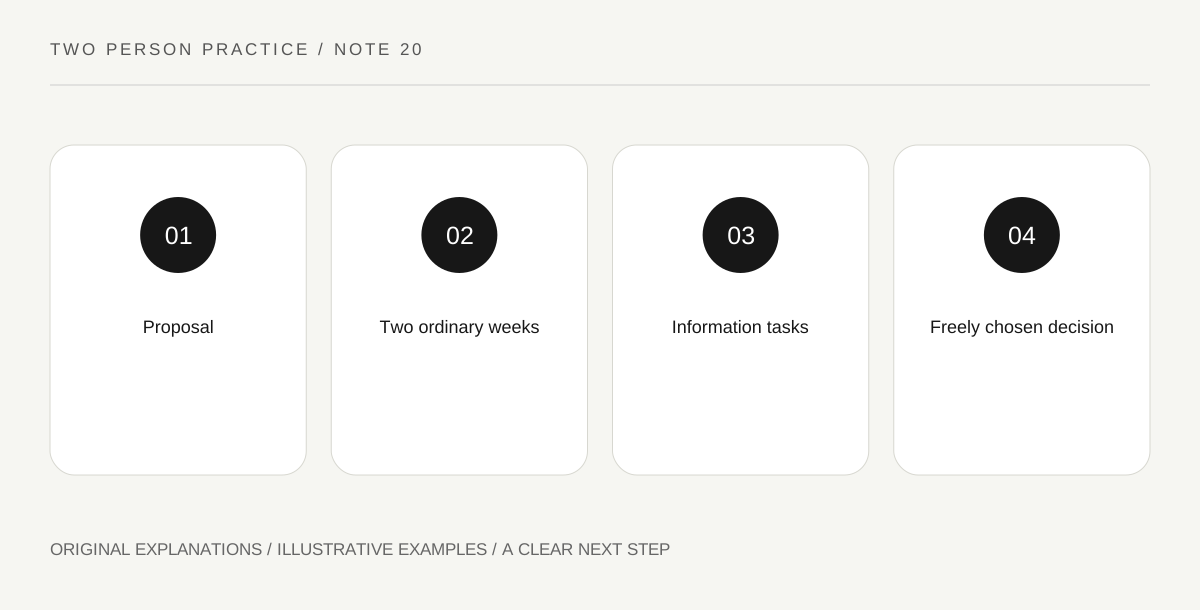
Original explanatory diagram. Read the full method and limitations below.
Name the proposal and its unknowns
State the possible destination, timing and reason using the information actually available. A job offer, a hope to relocate and an invitation to explore are different stages. Do not ask the partner to accept a decision that has already been made while calling it a discussion. Mark unknown details honestly. A shared page can include questions without implying that every uncertainty will be resolved by the end of one evening.
Describe effects on each person’s ordinary week
Consider work, travel, friendships, care responsibilities and the activities that make daily life meaningful. The adult receiving the opportunity should not be the only person whose future appears in detail. Ask the other to describe what they would lose, gain and need to investigate. Avoid assigning motives such as fear of success when a partner raises a concrete concern. The move affects actual routines, not only the appealing headline of a new opportunity.
Separate information gathering from commitment
One person can research official requirements while another explores appropriate work or community information, without either promising to move. Legal status, housing terms and costs need current reliable sources or suitable professional advice. This worksheet does not fill those gaps with generic assumptions. Agree which question each person will investigate and when you will compare findings. The research stage should remain a stage, not a disguised countdown to a decision already expected.
Keep several outcomes visible
The result might be moving together, delaying, declining or considering another arrangement. Each carries different implications that need honest discussion. Do not treat the only acceptable answer as immediate agreement in order to prove support. After gathering information, return to both people’s ordinary lives and priorities. A clear decision may still involve disappointment. The exercise aims to make the choice informed and freely expressed, rather than to guarantee that a major transition has no cost.
Illustrative worked example
Illustrative proposal: One adult receives a possible role in another city. They label it an opportunity to investigate, not a confirmed household move. Each maps a normal week in the current city and the questions a new location raises. One checks official employment details; the other explores their own work options. They agree on a later decision conversation and explicitly retain decline and delay as possible outcomes.
Questions that come up
Does declining a move mean refusing to support a partner?
No automatic conclusion follows. A major move affects both lives, and practical or personal concerns deserve a clear hearing.
Can a temporary trial settle every issue?
Not necessarily. A trial can provide information if feasible, but legal, work, housing and personal consequences still need appropriate consideration. Do not assume reversibility without checking the actual arrangements.
References and scope
These sources support the factual background. Examples and exercises are original illustrative teaching material. References do not imply endorsement.
- Gottman Institute: Questions before moving in together — Context for explicit discussion of cohabitation routines and expectations; exercises here are original.
- love is respect: Healthy Relationships — Mutual respect, equality and independent choice as boundaries for relationship education.