Protect time for a new personal goal without assigning the partner a support role
A course, creative project or training goal can change the time available in a relationship. This exercise helps an adult explain the goal’s practical footprint and ask for specific support, while the partner remains free to discuss their own needs and capacity.
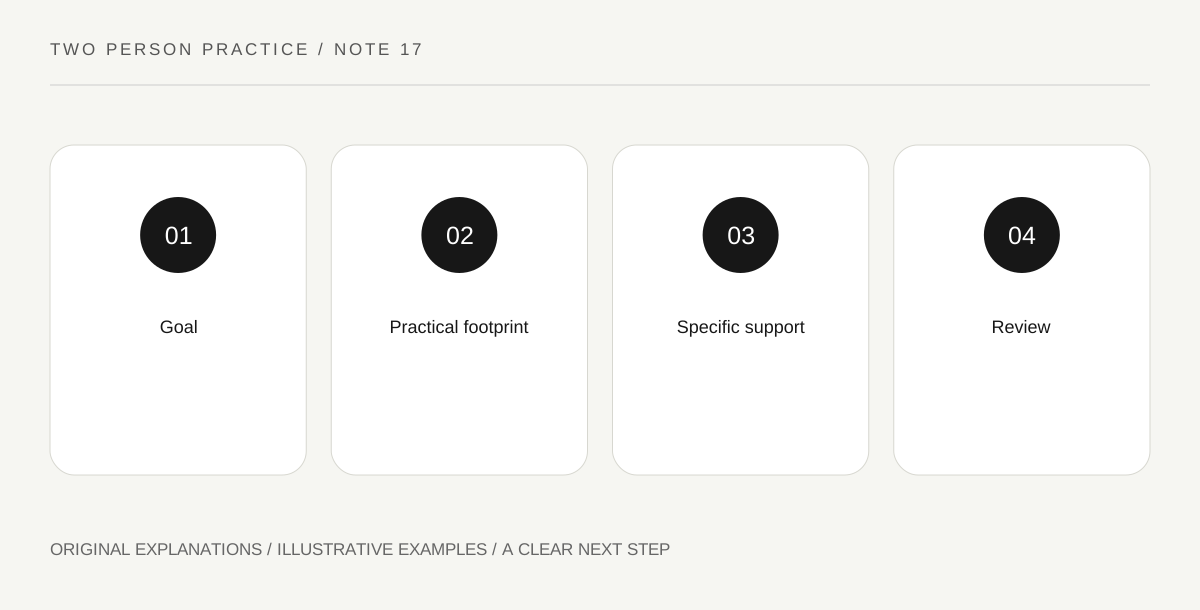
Original explanatory diagram. Read the full method and limitations below.
State the goal and the actual commitment
I want to take a weekly evening class is clearer than I need you to support my dreams. Name the time, preparation and likely duration of the commitment using current information. If important details are unknown, say so. The goal can matter deeply without making every practical question an attack on it. A concrete description gives both adults something to plan around rather than asking the partner to endorse an undefined change.
Separate encouragement from transferred work
A partner may be happy about the goal while unable to absorb extra household tasks. List any work that would shift and ask explicitly whether the proposed arrangement is manageable. Do not assume that emotional support includes automatic scheduling, transport or project management. The goal owner should remain responsible for their own planning unless another arrangement is freely agreed. This preserves the difference between cheering for someone and becoming the unseen organizer of their undertaking.
Make room for the partner’s own priorities
Ask what the new schedule affects and whether another commitment needs protected time too. Avoid treating the first announced goal as permanently more important. The discussion can produce a trial period, a smaller commitment or a different practical arrangement. Neither adult needs to prove that their interest is more valuable to deserve time. The useful question is how the actual commitments fit the shared responsibilities and independent choices both people recognize.
Review the arrangement at a natural point
Choose a check after a few sessions or another meaningful milestone. Ask whether the schedule and work division remain as expected. If the class becomes more demanding, return to the conversation rather than expanding the partner’s role silently. A review should not become a demand to demonstrate spectacular progress. It concerns the agreed practical footprint, while learning and creative outcomes can remain uncertain and personal.
Illustrative worked example
Illustrative goal: Ari joins a six-week fictional writing class that meets one evening a week. Ari explains the meeting time and homework, keeps responsibility for registration and asks about swapping one household task during the course. Morgan agrees to a limited swap and protects an evening for a separate interest. They review after two sessions because the homework took longer than expected. The adjustment concerns time and work rather than whose dream deserves more respect.
Questions that come up
Does asking practical questions mean a partner is unsupportive?
Not necessarily. A person can value the goal while needing clarity about time, work or other commitments.
Must every goal be a joint project?
No. Independent goals can remain independent. Ask for the support you want without assuming the partner must become a participant or manager.
References and scope
These sources support the factual background. Examples and exercises are original illustrative teaching material. References do not imply endorsement.
- Gottman Institute: Making the Invisible Visible — Context for noticing planning and organizing work within shared household responsibilities.
- love is respect: Healthy Relationships — Mutual respect, equality and independent choice as boundaries for relationship education.