Coordinate different bedtimes without making sleep a loyalty test
Adults can have different evening and morning schedules. This exercise focuses on the practical transitions that affect both people: light, noise, belongings and shared time. It does not diagnose sleep problems or prescribe a treatment, and it leaves room for arrangements both can freely choose.
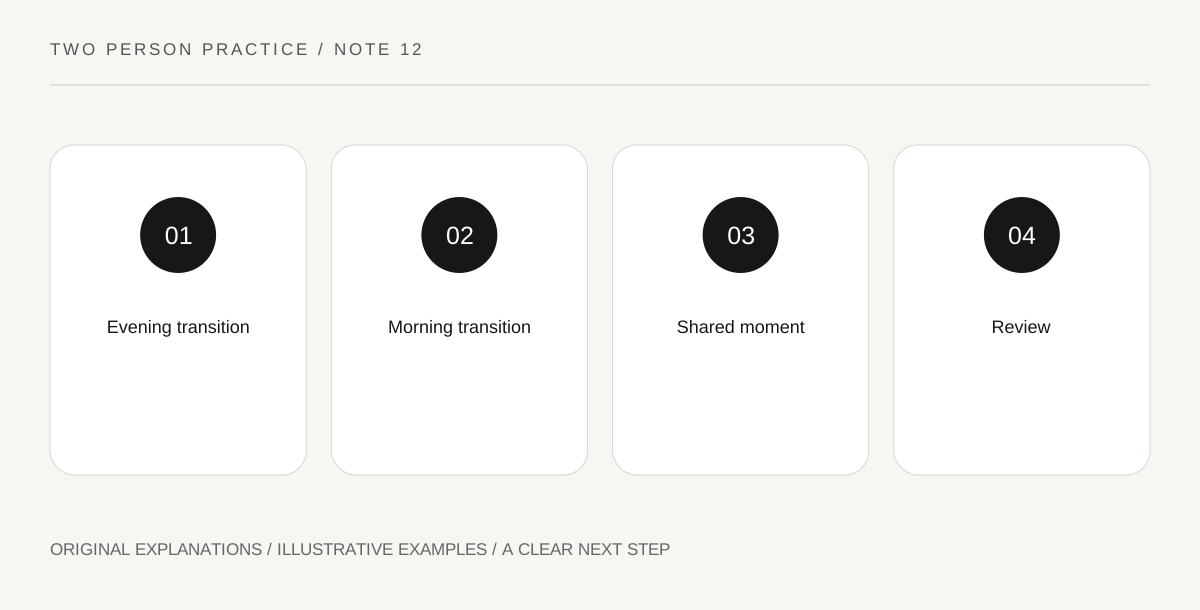
Original explanatory diagram. Read the full method and limitations below.
Describe the two transitions concretely
Write what happens when the earlier sleeper goes to bed and when the later sleeper arrives. Include ordinary actions such as choosing clothes, using a lamp or opening a drawer. Avoid starting with a judgment that one schedule is normal and the other inconsiderate. A concrete sequence can reveal a small preventable disturbance that a broad argument about bedtime personalities would miss.
Choose which tasks can move
Preparing clothes earlier or using another suitable area for a late task may reduce a practical conflict. The exact choice depends on the actual home and each person’s needs. Do not assume that every sound or light can be eliminated, and do not use this worksheet to minimize persistent sleep difficulties. If there is a health concern, appropriate professional guidance belongs alongside the household conversation rather than being replaced by a decorative routine.
Protect shared time through a separate agreement
Going to bed at the same hour is not the only possible way to connect. You might choose a brief conversation earlier in the evening or another shared moment both enjoy. Keep that choice separate from a demand that one adult prove affection by abandoning a necessary schedule. The exercise should identify the desired connection and a workable form, while respecting that rest and work obligations may differ.
Review the arrangement after real nights
Ask which transition was easier and what still caused difficulty. A missed preparation step can be revised without declaring the whole schedule incompatible. If the arrangement does not work, consider other freely agreed options and relevant professional advice rather than escalating a loyalty test. Record the evening transition, morning transition and chosen shared moment separately. This makes the plan specific enough to adjust without turning sleep into a score of closeness.
Illustrative worked example
Illustrative routine: One adult starts work early and sleeps earlier. The other prepares tomorrow’s clothes before that bedtime and uses an appropriate separate area for late reading. They share a short conversation after dinner because neither wants connection to depend on identical sleep timing. After several nights, they revise where the morning bag is kept. The example is a practical transition plan, not a claim that it treats insomnia or another medical condition.
Questions that come up
Does a different bedtime mean less affection?
No conclusion follows from the schedule alone. Ask about the person’s actual needs and the connection both want rather than assigning a motive.
Can this plan solve a sleep disorder?
No. It addresses shared-home logistics. Persistent or concerning sleep problems need appropriate professional assessment rather than an assumption that household planning is sufficient.
References and scope
These sources support the factual background. Examples and exercises are original illustrative teaching material. References do not imply endorsement.
- Gottman Institute: Questions before moving in together — Context for explicit discussion of cohabitation routines and expectations; exercises here are original.
- love is respect: Healthy Relationships — Mutual respect, equality and independent choice as boundaries for relationship education.