Offer practical help during a short disruption without taking over
When illness, an injury or another short disruption changes ordinary routines, useful help can be specific and chosen by the person receiving it. This exercise concerns household logistics and communication. It does not provide treatment, medical decisions or a substitute for professional care.
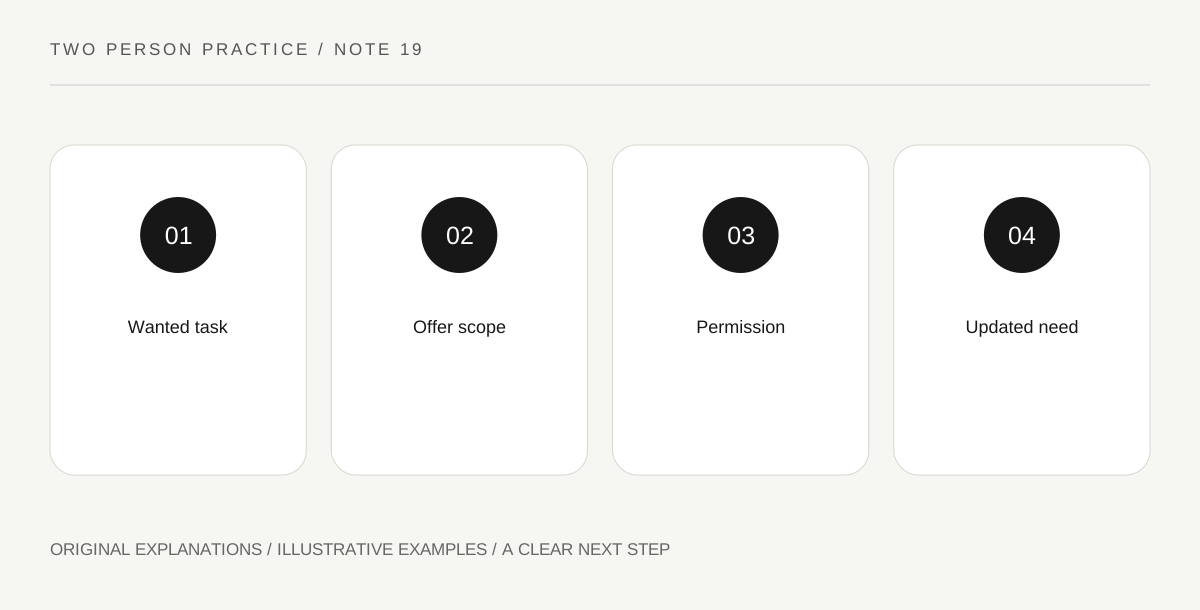
Original explanatory diagram. Read the full method and limitations below.
Ask which practical task would help
Offer a small menu if that is easier to answer: groceries, a household message or moving an ordinary appointment. Avoid assuming that the task you most enjoy doing is the one the other person needs. The person receiving help may want one action and prefer to handle another themselves. Keep the choice real. Support should not require surrendering all control over ordinary decisions merely because a routine has become difficult.
Clarify the scope of the offer
If you can handle one shopping trip, say that rather than promising to take care of everything. Ask what information is needed and use the person’s actual instructions. Medical care, medication handling and other specialized tasks need appropriate professional guidance; do not improvise them from a general relationship exercise. A useful household offer can remain modest and still matter, particularly when it removes one concrete task without creating another coordination burden.
Preserve permission around communication
Before contacting someone, sharing personal information or changing an appointment, ask what the person wants communicated and to whom. Do not announce their condition publicly or speak on their behalf merely because you are their partner. If they ask for help with a message, confirm its content and route. Practical assistance can support autonomy rather than replacing it, especially when a person has less energy to correct assumptions after a message has already been sent.
Review the arrangement as the disruption changes
A task needed today may not be needed next week. Ask whether to continue, stop or change the help instead of letting a temporary arrangement become permanent without discussion. The helper can also state capacity and ask for other appropriate support. Keep the review about current needs rather than measuring gratitude. The exercise ends with a clear next action and permission, while health concerns remain with the relevant qualified care.
Illustrative worked example
Illustrative assistance: During a short disruption, one adult asks the other to collect ordinary groceries and send a drafted message about postponing a social visit. The helper confirms the list and message rather than contacting everyone independently. They agree to check again the next day. No medical treatment, medication change or recovery timeline is inferred. The help is specific, limited and directed by the person receiving it.
Questions that come up
Should I do everything without asking to reduce their effort?
Not automatically. A short specific choice can prevent unwanted actions. Agree what can be handled independently and what still needs permission.
What if the help needed exceeds what I can offer?
State that honestly and discuss suitable additional support. A clear limit is more useful than a broad promise you cannot keep, especially when professional care is required.
References and scope
These sources support the factual background. Examples and exercises are original illustrative teaching material. References do not imply endorsement.
- love is respect: Healthy Relationships — Mutual respect, equality and independent choice as boundaries for relationship education.