Plan the first evening after one partner returns from travel
A reunion can contain different expectations: one person wants immediate time together, while the traveler needs a practical reset. This exercise plans the first evening after a work trip or other absence, separating arrival logistics, household handover and the connection both people want.
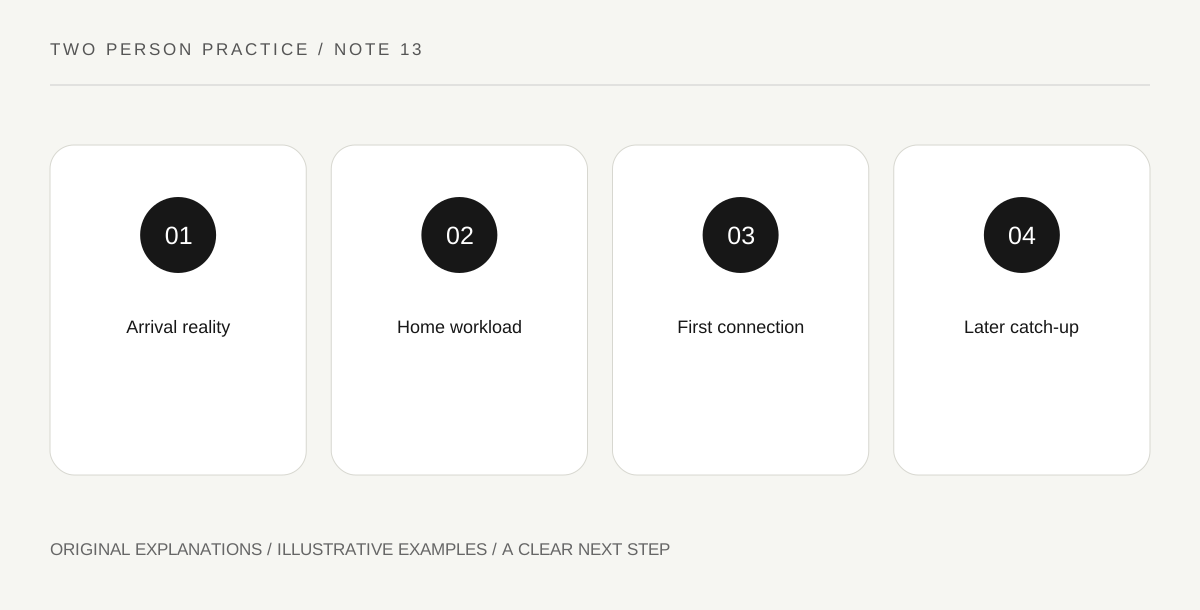
Original explanatory diagram. Read the full method and limitations below.
Ask what arrival will realistically involve
Name the travel day, approximate arrival and any uncertain delays. Include practical tasks such as putting away bags or getting food, without promising a precise emotional state. One person may picture an outing while the other imagines a quiet hour at home. Ask before arranging a surprise that requires energy or a fixed departure time. The exercise is about a particular transition, not a verdict on who missed the other more.
Describe the home-side workload too
The adult who stayed may have handled additional tasks during the absence. Make room for that reality without turning the reunion into an immediate accounting session. Identify any time-sensitive handover, such as a practical appointment or household delivery, and keep nonurgent topics for a suitable later moment. Both travel effort and home effort can exist. Recognizing one does not require dismissing the other or deciding whose week was harder.
Choose a modest first connection
A meal, a short conversation or another low-demand activity can be enough if both want it. State what remains optional. A reunion should not become a performance in which one adult must appear cheerful and fully available regardless of fatigue or circumstances. If a longer conversation is important, agree when it can happen rather than hoping the traveler will infer it from a disappointed reaction later in the evening.
Review the transition rather than the affection
Afterward, ask which practical part worked and what expectation was unclear. Perhaps the food plan was useful but the arrival time was too uncertain for an outside reservation. Revise that detail for a future trip. The worksheet’s purpose is a clearer arrival arrangement, not a guarantee that every reunion feels effortless. Keep the plan flexible enough to respond to the real travel day while preserving a chosen opportunity to reconnect.
Illustrative worked example
Illustrative return: A traveler expects to arrive around seven after a long journey. Their partner has handled the household all week and wants a conversation. They agree on a simple meal at home, a brief practical handover and a longer catch-up the next evening. If travel is delayed, the meal remains flexible. Neither treats the shorter first conversation as evidence that the other person did not care about the reunion.
Questions that come up
Should the person at home organize everything for the return?
Not automatically. Agree what each person can handle and which tasks can wait. A welcome does not require one adult to absorb all the planning.
What if I wanted a bigger reunion?
Say what experience you hoped for and discuss another suitable time. A large plan can be freely chosen later without making the arrival evening carry every expectation.
References and scope
These sources support the factual background. Examples and exercises are original illustrative teaching material. References do not imply endorsement.
- Gottman Institute: Making the Invisible Visible — Context for noticing planning and organizing work within shared household responsibilities.
- love is respect: Healthy Relationships — Mutual respect, equality and independent choice as boundaries for relationship education.