Share a household task from noticing through completion
A household task often begins before the visible action. Someone notices a need, plans the response and checks that it is finished. This original worksheet helps two adults discuss one small responsibility in full, rather than assigning a visible chore while leaving its organization unspoken.
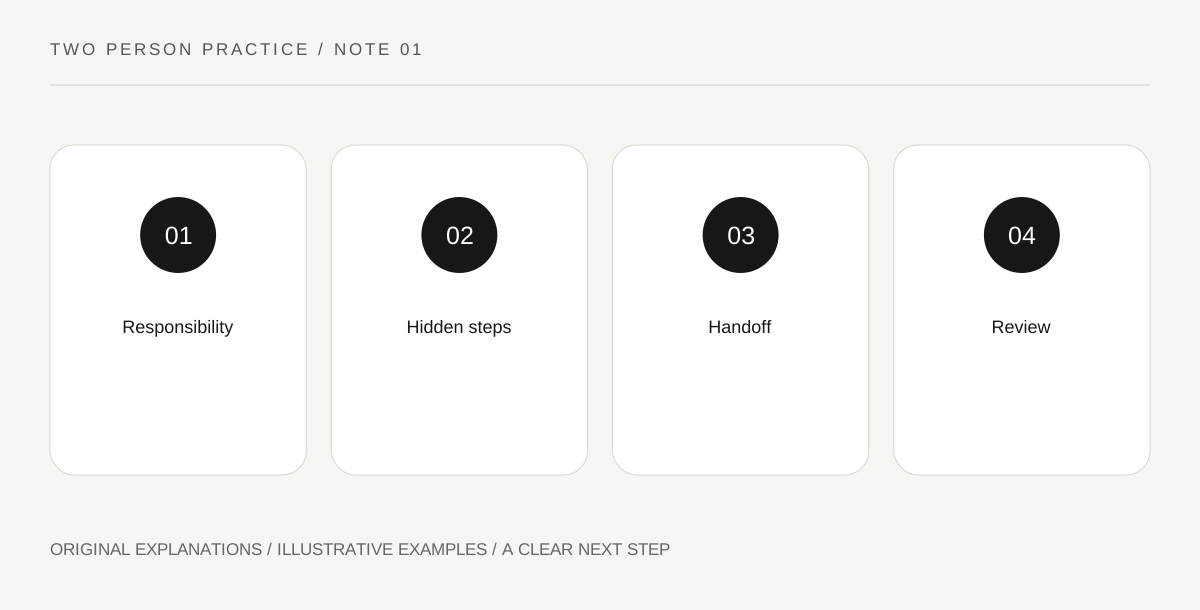
Original explanatory diagram. Read the full method and limitations below.
Choose one bounded responsibility
Start with something concrete, such as keeping the ordinary kitchen cloths ready for use. Avoid beginning with everything about the house. Describe what counts as a usable result and when the need arises. One person may think the task means running a wash; another may include noticing low stock and returning clean cloths to the right place. The difference is useful information about the task, not proof that one person is naturally better at household management.
List the steps that happen offstage
Write noticing, gathering supplies, doing the task and completing the return as separate actions in your own words. Include only steps that actually apply. This makes the planning work visible without turning the exercise into a competition over who has been more exhausted. Ask which parts each person currently handles and which parts neither person realized existed. Keep the list about this responsibility rather than using it to prosecute every unresolved disagreement.
Agree on a complete handoff
If one adult takes responsibility, clarify what they can decide independently and what information they need. A handoff that still requires the other person to issue reminders may leave the original planning burden unchanged. At the same time, do not use ownership to prohibit questions or reasonable help. Choose an arrangement that both freely accept, taking actual schedules, capacity and preferences into account rather than dividing work by a gender assumption.
Review the result rather than scoring the person
After the agreed trial period, ask whether the useful outcome happened and whether the arrangement was manageable. If not, locate the missing step or unrealistic expectation. A temporary adjustment is different from a verdict that someone is incapable. The worksheet’s success is a clearer shared responsibility, not a perfect score. Keep the review short enough that it can revise the arrangement without becoming another large task for the same person to organize.
Illustrative worked example
Illustrative agreement: Jo and Alex choose kitchen cloths as a small task. Alex takes responsibility for noticing when the supply is low, following the actual care instructions, arranging the wash and returning clean cloths. Jo explains the existing storage place once. They review after a week and discover that the return step needs a clearer location. They change the storage label rather than treating the missed return as a judgment about Alex’s character.
Questions that come up
Must tasks be divided into identical halves?
No. This exercise seeks an arrangement both consider workable and fair. Different schedules or capacities can support different divisions without making one person the permanent manager.
What if a partner asks how to do it?
Questions can be reasonable. Distinguish learning the task from repeatedly transferring all planning back to the other person, and agree what information would make the handoff complete.
References and scope
These sources support the factual background. Examples and exercises are original illustrative teaching material. References do not imply endorsement.
- Gottman Institute: Making the Invisible Visible — Context for noticing planning and organizing work within shared household responsibilities.
- love is respect: Healthy Relationships — Mutual respect, equality and independent choice as boundaries for relationship education.