Share a work-from-home day through a noise and space map
Two adults working in one home may need different spaces at the same time. A simple map of calls, concentration tasks and shared areas can reveal the practical conflict. This exercise plans one day without treating either person’s work as automatically more important.
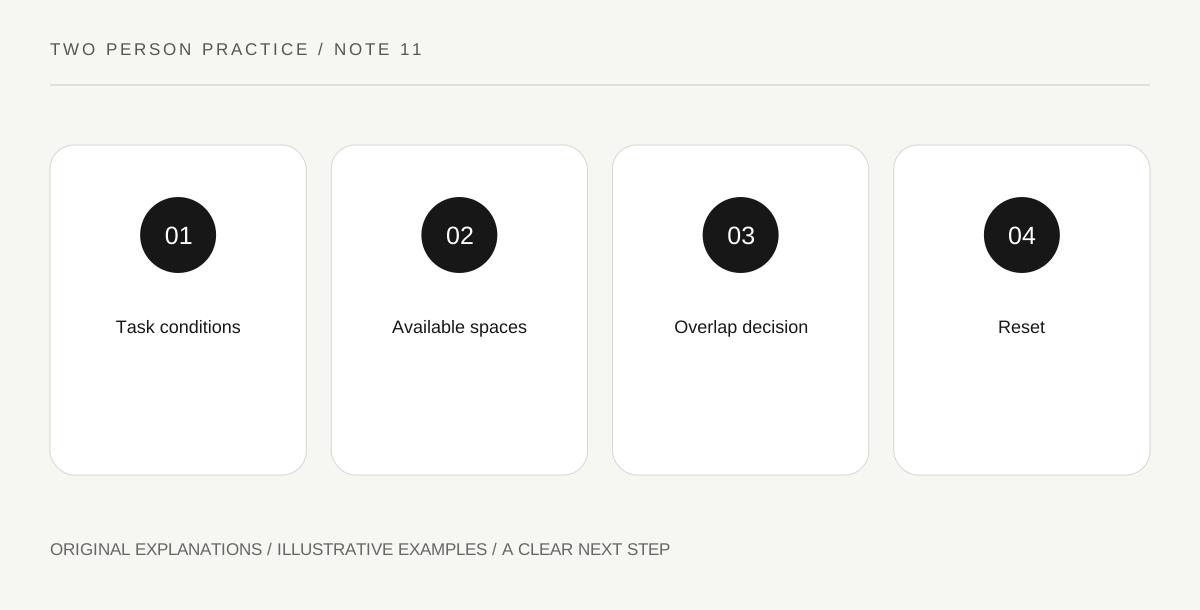
Original explanatory diagram. Read the full method and limitations below.
List the tasks that need particular conditions
Name the actual work blocks, such as a client call, quiet reading or a task that can happen elsewhere. Avoid labeling one person noisy and the other oversensitive. The conditions belong to specific activities. Include start and end times where known, and mark uncertain calls honestly. A map that assumes every hour is equally inflexible may hide useful options, while a map that treats one person’s work as optional creates another problem.
Mark the available spaces realistically
Identify rooms or areas that can be used for each task, including appropriate privacy and equipment needs. A kitchen chair may be physically available but unsuitable for a long work block. Do not assume a closed door solves every sound issue or that headphones meet every privacy requirement. This worksheet is a household planning exercise, not an acoustic or ergonomic assessment. Note which practical questions require other information before relying on a proposed arrangement.
Resolve one overlap at a time
When both need the same area, compare options such as shifting a flexible task, choosing another appropriate location or changing a nonessential call time. Neither adult should have to surrender the whole day because the other scheduled first. Ask which part is genuinely fixed and which is a preference. Make the agreement specific enough to use: the study is reserved for a particular call, while the dining table remains shared afterward.
Plan the reset and unexpected change
State how you will signal a call running late and when the shared area returns to ordinary use. Avoid making the other person monitor your meeting status constantly. A direct short message can be enough. At the end of the day, review the overlap that caused difficulty and adjust the next plan. The goal is a workable shared environment, not a permanent hierarchy in which one career owns the quiet space.
Illustrative worked example
Illustrative day: Ana has a fixed call at ten, and Drew needs a quiet hour for editing sometime before lunch. They reserve the study for Ana from ten to eleven and for Drew afterward. Ana sends a short update if the call overruns rather than silently occupying the room. The dining table remains available for less private tasks. Their review concerns the actual overlap, not whose job deserves greater respect.
Questions that come up
Must a home have two offices to share workdays?
No universal arrangement fits every home. Start with actual tasks and appropriate spaces, while recognizing that some constraints may require outside workspace or another practical solution.
Who gets priority when both calls are fixed?
Discuss the specific needs and available alternatives. A standing rule based only on income, seniority or who asked first may not reflect the actual household agreement.
References and scope
These sources support the factual background. Examples and exercises are original illustrative teaching material. References do not imply endorsement.
- Gottman Institute: Questions before moving in together — Context for explicit discussion of cohabitation routines and expectations; exercises here are original.
- love is respect: Healthy Relationships — Mutual respect, equality and independent choice as boundaries for relationship education.